
More help with self-assessment tax bills
If you haven’t paid what you owe within 30 days of the filing date of your self-assessment return for that year, you’ll be charged a penalty. The good news is that HMRC has relaxed this rule for the 2019/20 tax year. What’s the full story?
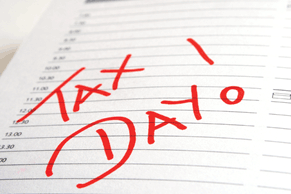
HMRC has today (19 February) announced that self-assessment taxpayers won’t be charged the automatic 5% late payment penalty if they pay what they owe for 2019/20 or set up a payment plan by 1 April 2021.
Normally, a 5% late payment penalty is charged on any unpaid tax that is still outstanding on 3 March following the end of the tax year. But this year, because of the impact of the pandemic, HMRC is giving taxpayers more time to pay or set up a payment plan.
Note that HMRC will stick to the normal rule of charging interest at 2.6% per annum for all self-assessment bills not paid on time.
You can pay your tax bill or set up a monthly payment plan here. You need to do this by midnight on 1 April to prevent being charged a late payment penalty.
Related Topics
-
Government launches consultation package on HMRC powers and tax administration
The government has launched a wide-ranging package of consultations on tax administration, including proposals to strengthen HMRC's debt recovery powers, modernise tax agent regulation and expand the use of digital services. Several of the measures could have significant implications for taxpayers and advisers. What has been proposed?
-
What are HMRC’s new procedures for export evidence?
HMRC has updated its guidance about the proof of export you must retain if you ship goods abroad and zero-rate the sales. How will the new guidance affect your business?
-
Getting out of the child benefit tax trap
You expect to earn over £60,000 for this tax year which means you may have to pay back some or all of your family’s child benefit due to the high income child benefit charge (HICBC). Is it possible to reduce the charge?




 This website uses both its own and third-party cookies to analyze our services and navigation on our website in order to improve its contents (analytical purposes: measure visits and sources of web traffic). The legal basis is the consent of the user, except in the case of basic cookies, which are essential to navigate this website.